
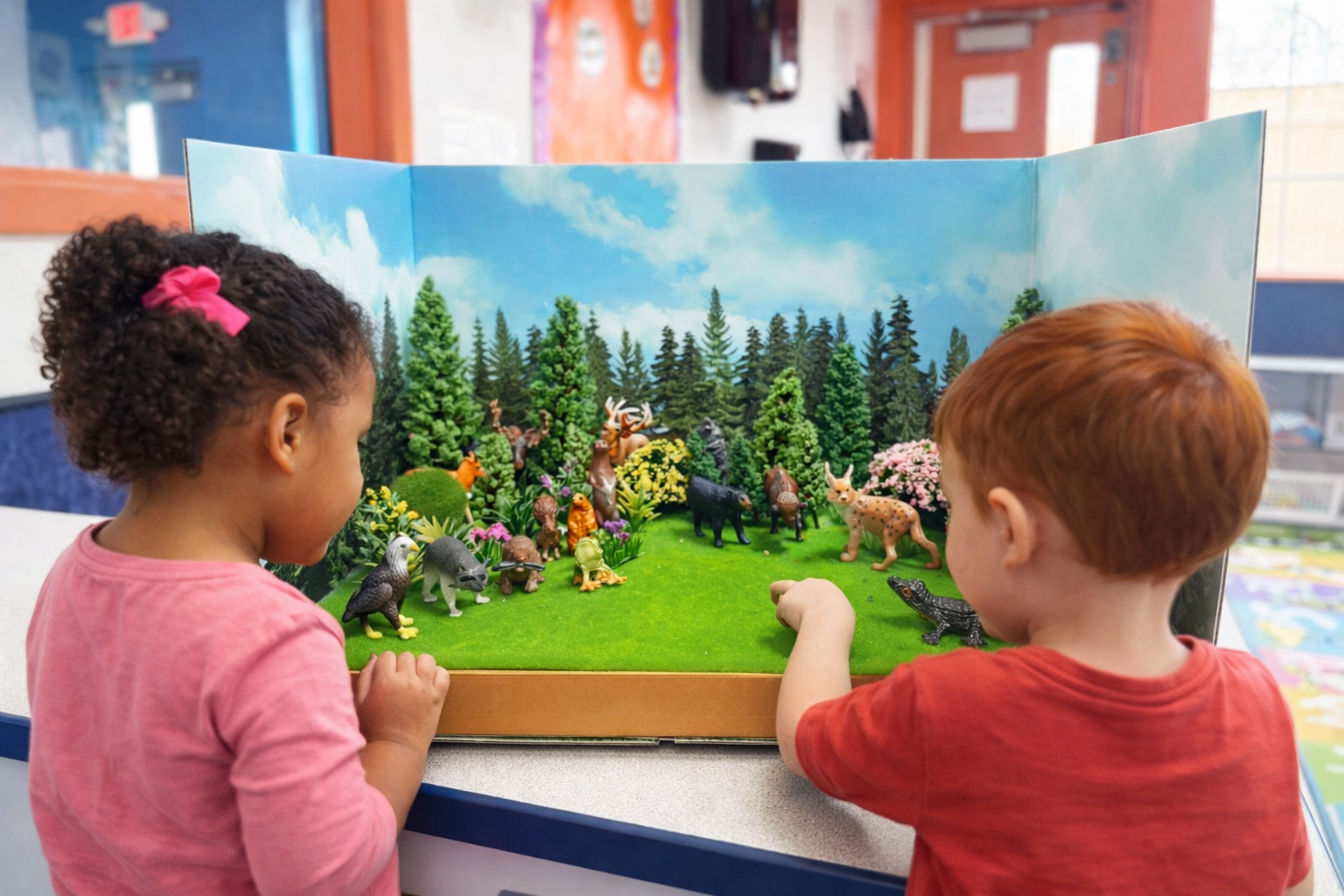
This week in our classroom, one activity my tiny humans truly loved was creating a forest animal diorama. Activities like this are wonderful because they combine creativity, exploration, and meaningful learning in early childhood education.
To begin the activity, I invited the children to help create a natural forest habitat inside a diorama box. Together, we arranged the materials to resemble a forest environment where animals could live. The children were excited to participate and eager to help build the tiny world we were creating.

Once the habitat was ready, the children were given small woodland animal figures to place inside the forest. Because the animals were very realistic, the children immediately began observing their shapes, features, and colors.
As a preschool educator, I encouraged the children to name the animals and talk about what they noticed. They shared ideas about the animals’ bodies, their fur, their size, and how they might move in the forest.
Our conversation naturally expanded as we explored questions together:
• What does this animal eat?
• Where might it sleep?
• How does it survive in the forest?
The children eagerly shared their thoughts and helped each other think about the animals’ lives in their natural habitat. What began as a creative activity quickly turned into a rich discussion about nature, animals, and survival in the forest.
Moments like these remind me how powerful play-based learning can be. When children explore through hands-on activities, they become curious thinkers and enthusiastic learners.
Materials Used
For this activity, we used simple materials to build a mini forest habitat that the children could explore and interact with.
Materials
• Diorama board or box
• Fake grass or green craft sheets for the forest floor
• Woodland animal toy figures
• Styrofoam blocks to create hills or raised areas
• Double-sided tape
• Brown or orange masking tape for assembly
These materials allowed the children to create a small forest scene where they could place animals and imagine how they live in their natural habitat.

Learning Skills Developed
This forest animal diorama activity supported several important developmental skills in early childhood learning.
Language Development
Children practiced naming animals and describing their features. They discussed what the animals looked like and how they might move or behave.
Science and Nature Awareness
The activity introduced basic ideas about animal habitats, food sources, and survival in nature.
Observation Skills
Because the animal figures were realistic, the children carefully observed their shapes, textures, and characteristics.
Imagination and Creative Thinking
Building the forest environment encouraged children to imagine where animals live and how they interact with their surroundings.
Social Interaction
Children shared materials, exchanged ideas, and listened to one another during the activity.
Fine Motor Skills
Placing small animals and arranging materials strengthened hand coordination and control.
Teacher Tip
You can extend this activity by leaving the forest diorama in the classroom for several days. Children enjoy returning to the habitat and continuing their exploration.
Each day, introduce a new question such as:
• Which animals live in trees?
• Which animals live on the forest floor?
• What foods do forest animals eat?
• How do animals stay safe in the wild?
You can also add new materials such as sticks, rocks, leaves, or a small blue paper stream to represent water. These additions encourage children to continue exploring the forest environment.

Two students closely observe the forest animal diorama as they identify animals and discuss their habitat.
Suggested Extension Activities
This activity can easily expand into several additional learning experiences.
Animal Sorting Game
Have children sort the animals by size, habitat area, or type.
Forest Animal Storytelling
Invite children to create a story about what their animal is doing in the forest.
What Do Animals Eat? Matching Game
Use pictures of foods such as berries, fish, nuts, or leaves and have children match them to the animals.
Animal Movement Activity
Ask children to move like the animals in the forest. They can stomp like a bear, hop like a rabbit, or crawl like a raccoon.
Nature Walk Connection
Take the children outside and observe natural spaces that might resemble a forest habitat.
Final Thoughts
Hands-on activities like this forest animal diorama allow children to explore the world around them in meaningful ways. Through play, discussion, and imagination, tiny humans develop language, science awareness, and social skills.
As a preschool educator, it is always exciting to watch children build, explore, and discover together. Activities like this remind us that learning in early childhood education can be joyful, creative, and full of curiosity.
Leave a Reply